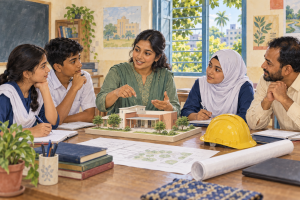
Science lessons can be a time to test predictions through observation and explain reasons, as well as learn facts. This article considers education in Bangladesh by looking beyond the appearance of a finished model to the questions children ask and how they investigate them.
Begin science learning with a question
In 2023, UNICEF described secondary-school students in Bangladesh undertaking practical science projects. This is a historical example, not a statement about current lessons or national policy. Source: UNICEF’s account of a student exploring science.
UNESCO MGIEP’s account of its LIBRE approach describes inquiry as learning through individual or collective observation, thinking and reasoning. Source: UNESCO MGIEP on LIBRE.
The following examples help explore these ideas in lessons. They are not KIZUNA programmes or experimentally validated teaching sequences. Teachers should choose activities suited to students’ ages and the school’s learning content.
Turn “What might happen?” into a question to investigate
Imagine making a small bridge by laying paper across two supports. Go beyond “Make a strong bridge” to a narrower question: “With the same paper, how might changing its folds affect how it supports a load?” Deciding what to compare is the starting point.
Before testing, record what children predict for flat and folded paper, and why. Predicting need not be a contest to guess correctly. It creates a record of ideas based on experience to compare with later observations.
Decide what to change and what to keep the same
To compare folds, one approach is to keep the paper type and size and the distance between supports the same. If one sheet is thicker and its supports farther apart, it becomes harder to explain what affected the result. Agree with children on what will change in this test.
Also decide what object to place on the bridge and where. This compares tabletop models; it does not test the safety of real buildings. Teachers should check the supports’ stability and select small learning materials that will not pose a danger if they fall. Do not extend the activity to people standing on bridges or large loads.
For repeated tests, consider whether an earlier trial damaged the paper. Record differences when conditions cannot be kept exactly the same. Recognising an uncontrolled difference also helps interpret results.
Record observations separately from explanations
A notebook can have sections for the question, prediction, method, observations and interpretation. “The middle sagged” is an observation; “the folds may have mattered” is a possible explanation. Instead of only writing “It was weak,” use drawings or short sentences to record what happened and where.
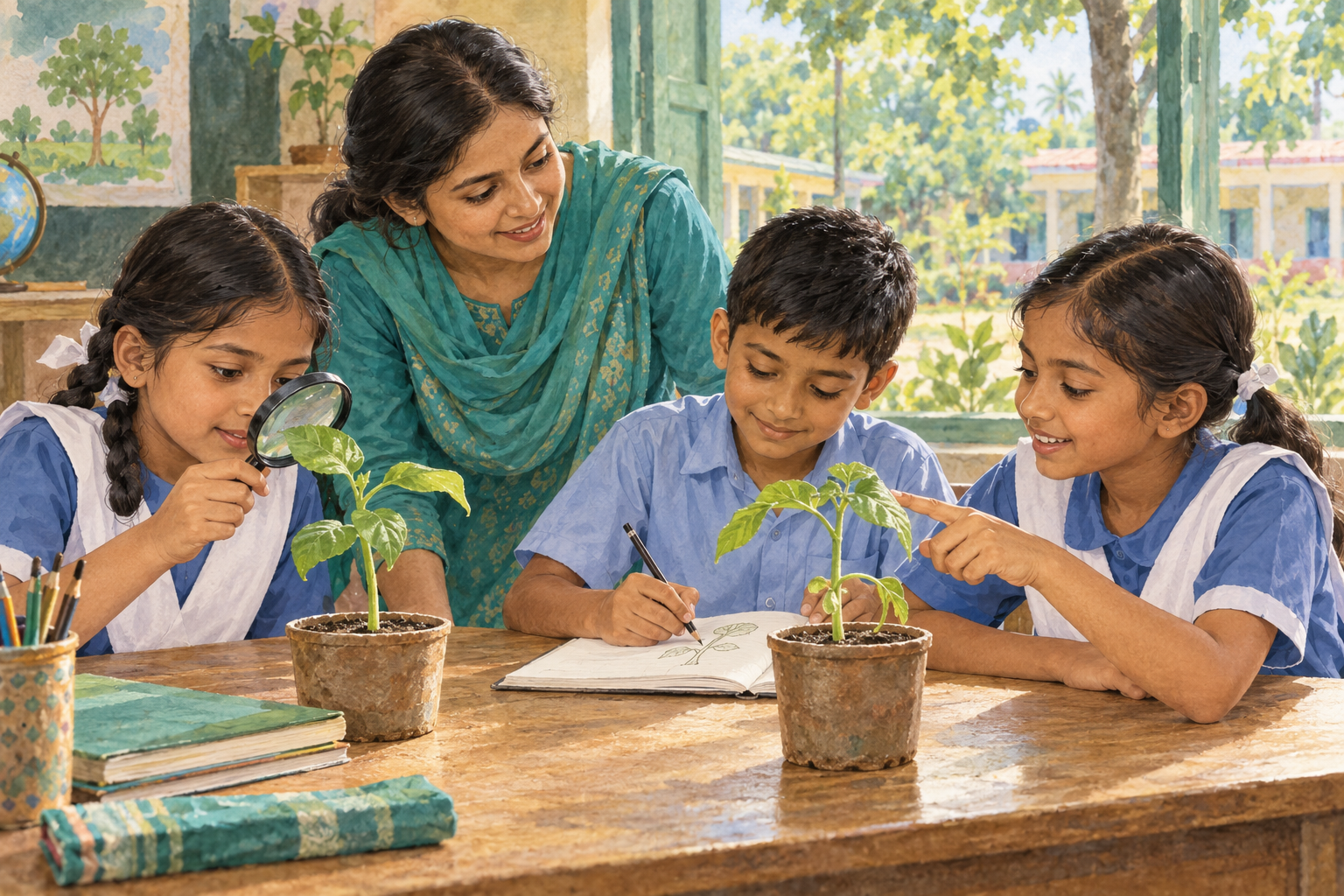
When drawing leaves on a potted plant, children can record visible features such as outlines and how leaves are arranged. A single view, however, cannot explain what caused the plant to grow that way. Distinguish describing observations from making comparisons to investigate reasons.
If a result differs from a prediction, there is no need to rewrite the record to look correct. Discuss whether the paper shifted or whether another explanation is possible, using the recorded conditions. Do not extend one result to “all paper”; state the limits of this investigation.
In groups, children can rotate between handling materials, observing and recording. Leave time for everyone to share at least one observation, rather than letting one confident speaker produce the whole explanation. Pointing to a drawing or the model can also help them explain.
Move from “Did it work?” to the next question
At the end, discuss what the records suggest and what remains unknown. Even if a model collapsed, recorded conditions and changes can help identify the next comparison. Assess more than the quality of the finished object.
Teachers can check whether children connect a question with a comparison and use observations to support an explanation. Rather than only supplying a conclusion, ask, “Which part of your record led you to think that?” Necessary facts and terminology can also be explained in connection with observations.
Frequently asked questions about scientific inquiry
Has the activity failed if the prediction was wrong?
A difference between prediction and result offers a reason to reconsider an explanation. Check what changed and what was observed, then name what to investigate next. Do not rewrite the result to fit the prediction.
Must everyone reach the same conclusion?
If results differ, compare materials, procedures and records first. Do not choose a correct answer by majority vote. Consider different conditions or further checks. Ideas can vary, but explanations should refer to observational evidence.
Learn about KIZUNA’s education-related work on our support programmes page. To discuss contributing, please contact us.
Sources checked: 13 October 2026.