Music education involves more than practising songs. It can also mean listening for differences, exploring pulse and rhythm, and shaping expression with others. This article considers music in Bangladesh’s schools as part of everyday lessons, beyond preparing for a special performance.
Make culture and the arts part of school learning
The framework for culture and arts education adopted by UNESCO Member States in 2024 emphasizes local cultures and heritage within education. Source: UNESCO on adopting the framework.
UNESCO’s explainer includes music among forms of culture and arts education, and recognizes artists and cultural practitioners as people who transmit knowledge. Source: UNESCO’s introduction to culture and arts education.
The following are lesson ideas informed by this perspective. They do not describe Bangladesh’s current curriculum, practice in all schools, or KIZUNA’s activities. Local teachers should select them according to children’s ages and experience and their school’s approach.
Choose one question for listening
Before a short performance, share a question such as “Does the same pattern of sounds return?” Rather than asking children to memorize every title or instrument name immediately, leave time to notice a passage they want to hear again. This gives listening a purpose beyond playing a long piece from start to finish.
“I like it” or “It feels cheerful” are valid responses. Then ask, “Which part made you feel that?” Children can connect feelings to musical features by identifying where more sounds entered or the music suddenly became quiet. Their responses need not converge on one correct interpretation.
Explore a steady pulse and changing rhythms separately
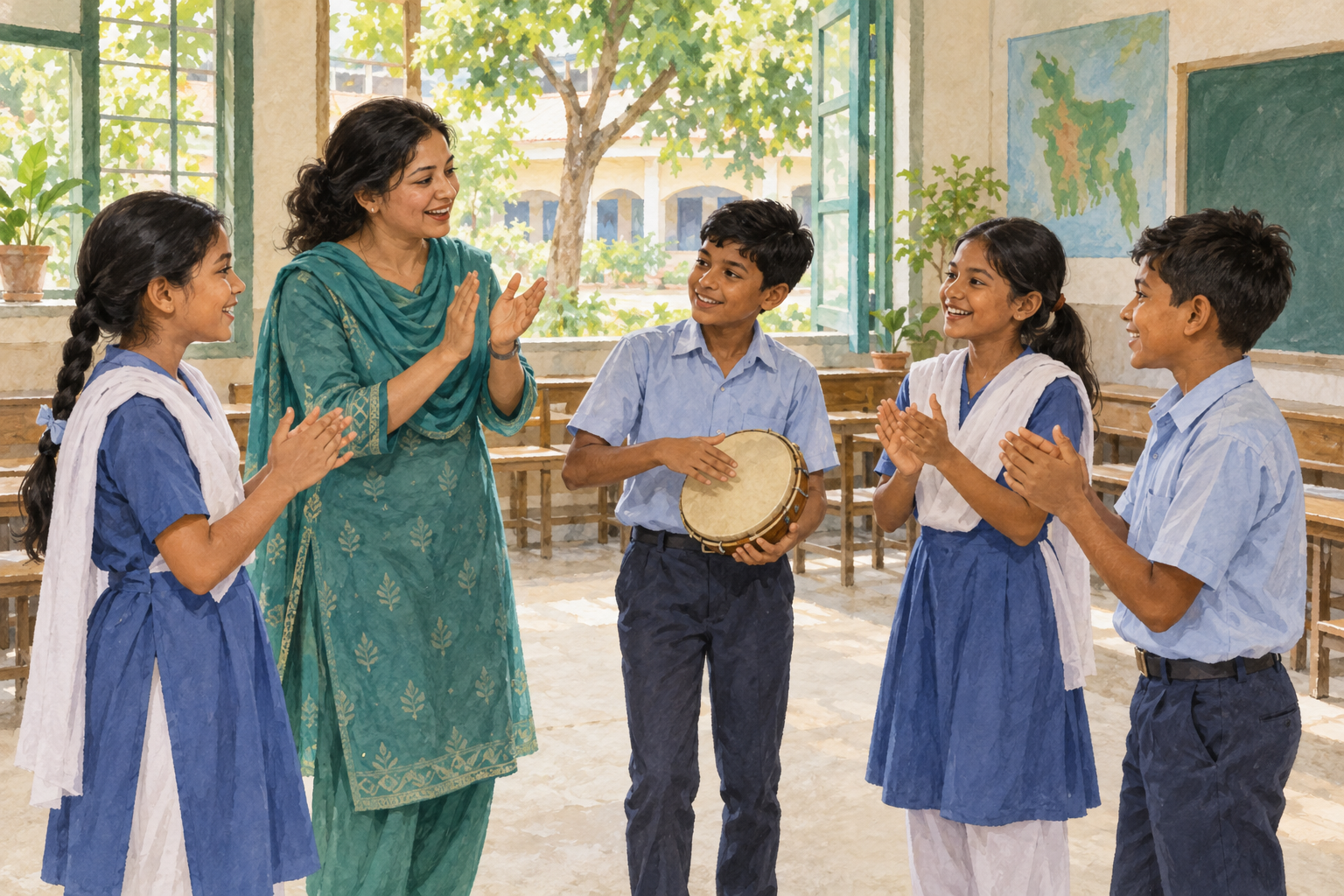
Begin with slow movements at regular intervals to feel the pulse. A teacher can clap a short pattern against that pulse for children to echo. They can experience how the lengths of sounds and the spaces between them vary even while the pulse continues.
Once familiar, combine sounds and rests within four beats, with one child creating a pattern and another answering. Agree to listen for the other person’s ending before joining in, instead of competing to go faster. Treat silent rests as part of the expression.
Listen separately to pitch and loudness
A high sound and a loud sound are different features. Using a voice or an instrument the teacher can play, compare changes in loudness at the same pitch with changes in pitch at a similar loudness. Avoid changing everything at once; clarify what children are listening for.
Children might draw a rising line for an upward movement in sound or use larger and smaller marks for changes in loudness. These are temporary signs for communicating what they hear, not a prescribed replacement for musical notation. Explain one another’s signs before using them together.
Turn short improvisations into musical exchanges
For example, one child makes a short call using two pitches and another answers within the same duration. They can begin by copying, then change only the final note. Instead of leaving “Be completely free” unexplained, limiting pitches and duration gives children something specific to discuss and vary.
In small groups, assign roles for keeping the pulse, adding a short pattern, and signalling the beginning and ending. After playing once, choose one change, such as coordinating an entrance or making the ending softer, then try again. Avoid arrangements in which the loudest performer always dominates.
For a child reluctant to use their voice, signalling or describing what they heard can be options. Teachers should adjust volume and activity length and allow a break if sound feels uncomfortable. Discuss participation with each child rather than requiring everyone to shout or sing solo.
Introduce local music with its context
When choosing a piece, ask local teachers or cultural practitioners who has passed it on and in what settings. Avoid treating one piece as representative of an entire country; discuss the meaning of lyrics and occasions for performance. This helps avoid presenting music simply as an unusual sound detached from its cultural context.
In reflection, discuss which differences children noticed, how they responded to another person’s sound, and how they changed the feeling they wanted to express. Recognize both listening and expression, beyond the polish of a performance or the applause it receives.
Frequently asked questions about music education
Do we need expensive instruments to begin?
Listening, responding with handclaps and making short vocal phrases are possible activities. If introducing instruments, consider the learning purpose, who can teach them, and arrangements for storage and care.
Does every child need to sing alone in public?
That is only one way to participate. Small-group exchanges, cues and descriptions of musical features can be combined. Decide what the lesson aims to teach, then choose ways to participate that fit that aim.
Learn about KIZUNA’s education-related work on our support programmes page. To discuss contributing, please contact us.
Sources checked: 14 October 2026.