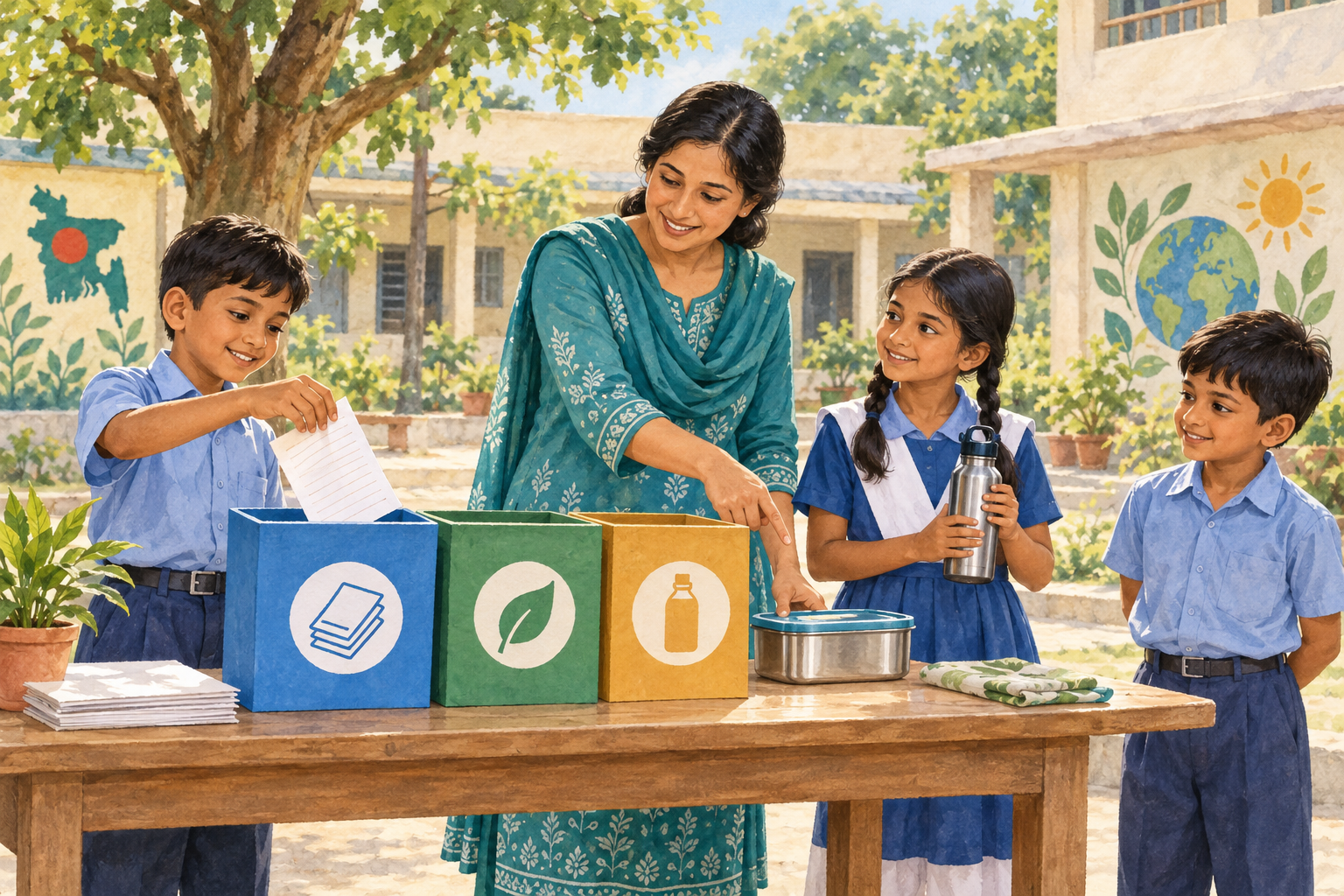
Reducing school waste means more than providing sorting bins: consider what is discarded, how to reduce it and who collects separated materials. This article looks at environmental education in Bangladesh through everyday school operations. The aim is to connect use and collection systems, rather than stop at a single cleanup event.
Connect environmental education with school operations
In 2021, the World Bank described Bangladesh’s sustainable plastic management action plan through the 3Rs: reduce, reuse and recycle. This was a policy direction, not a report of targets achieved. Source: World Bank, Sustainable Plastic Management.
UNESCO’s 2024 Green school quality standard includes facilities and operations, governance and community engagement alongside teaching. It offers a whole-school framework. Source: UNESCO Green school quality standard.
The following are planning examples, not reports of KIZUNA programmes or particular schools. Agree on sorting and collection with local responsible parties.
Start by looking at what arises and where
For example, identify where paper and packaging arise in classrooms, offices or around a school shop. Children need not open mixed rubbish bags. Adult-managed records or clean examples before disposal can support discussion about what to reduce.
Look beyond “a lot of waste” to its causes: an event, perhaps, or extra copies of the same handout. Rather than competing to collect more, begin by finding ways to avoid unnecessary waste.
Change use before considering disposal
For handouts, check how many copies are needed and whether the same notice is being distributed repeatedly. If switching to a display, check that everyone who needs the information can receive it. Reducing waste must not prevent access to learning information.
Adults should check whether items proposed for reuse are suitable. Do not gather broken objects or containers of unknown use merely as craft supplies. Storing things “just in case” can create clutter and management problems. Decide on both a use and a storage place.
Base sorting on what collectors accept
Accepted materials and conditions vary by collector. Before creating detailed categories, establish who will take the items, where they go and what is accepted. Placing something in a bin labelled “recycling” does not prove it has been recycled.
Labels might show drawings or photographs of items the school actually uses. Provide someone to ask about ambiguous items. Use words and examples as well as colour, and place bins where they are accessible without blocking routes.
Agree on collection days, storage and the person handing materials over, plus a contact for missed collections. If sorted materials are later mixed, review the handover process rather than simply asking children to sort more carefully. Consult the people who clean and collect too.
Separate children’s participation from adults’ duties
Children can design labels, suggest ways to reduce single-use items or draw the collection process. Broken glass, batteries and chemical containers, however, require adults to consult appropriate collection services. Do not ask children to sort hazardous items or make waste burning an activity.
Success is not simply rewarding whoever collects most. Review whether spare printouts decreased, labels caused less confusion or handovers happened as planned. Consistent recording conditions make it easier to discuss what a change achieved.
Distinguish the amount collected from the amount actually recycled. Do not claim outcomes that the recipient cannot confirm. Asking questions and separating school-level improvements from needs for community cooperation is itself an opportunity for environmental learning.
Frequently asked questions about school waste reduction
Are more types of sorting bins always better?
Increasing their number is not the goal. Match categories to what collectors accept and what the school can maintain, with clear labels for users.
Does a cleanup event solve the waste problem?
Cleanup is one activity. Also examine what is discarded, whether use can be reduced and whether collection continues, connecting the event to everyday operations.
Explore KIZUNA’s current activities on our support programmes page. To discuss contributing to education, please contact us.
Sources checked: 13 October 2026.