When considering mathematics education in Bangladesh, it matters whether children understand what numbers represent, as well as whether their answers are correct. Counting objects, comparing quantities and making groups of ten offer ways to explore this understanding. Here we consider how familiar materials can connect with drawings and equations.
Foundational numeracy involves more than calculation
UNICEF’s foundational learning assessment examines number identification, comparison, addition and patterns. This offers a perspective beyond judging number understanding from calculation alone. Source: UNICEF Data’s explanation of foundational learning skills.
A September 2026 UNICEF report examines teaching adjusted to students’ understanding in Bangladesh’s secondary schools. It does not directly establish the effectiveness of the early-primary examples below. Source: UNICEF’s report on differentiated teaching.
1. Connect counting words with “how many”
The following are examples for planning lessons, not descriptions of KIZUNA projects or every Bangladeshi classroom. Choose manageable materials such as paper cards or blocks according to children’s ages and learning experience.
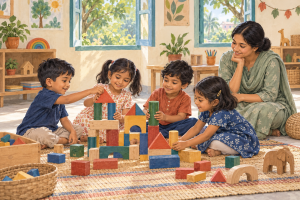
Place five blocks down and count them while pointing to each one. Then ask, “How many are there altogether?” This checks whether the final word “five” represents the total quantity, rather than being treated as the name of the last block.
Next, spread the same five blocks out or move them closer together, and ask whether the quantity changed. If none were added or removed, there are still five, despite the spacing. If the child is unsure, allow them to check each object again without rushing the answer.
2. Compare quantities by matching one to one
Arrange six cards and eight cards in two rows, pairing one from each row. Seeing two cards left over in the row of eight can help children consider not only that eight is more, but that it is two more. The comparison relies on matching objects rather than the length of a row.
Check whether children can make the same comparison after the arrangement changes. Before asking them to write comparison symbols, ask what they looked at to decide. This can guide the next explanation. Leave time for each child to try, rather than assuming that hearing a classmate’s answer means understanding.
3. Make place value visible with groups of ten
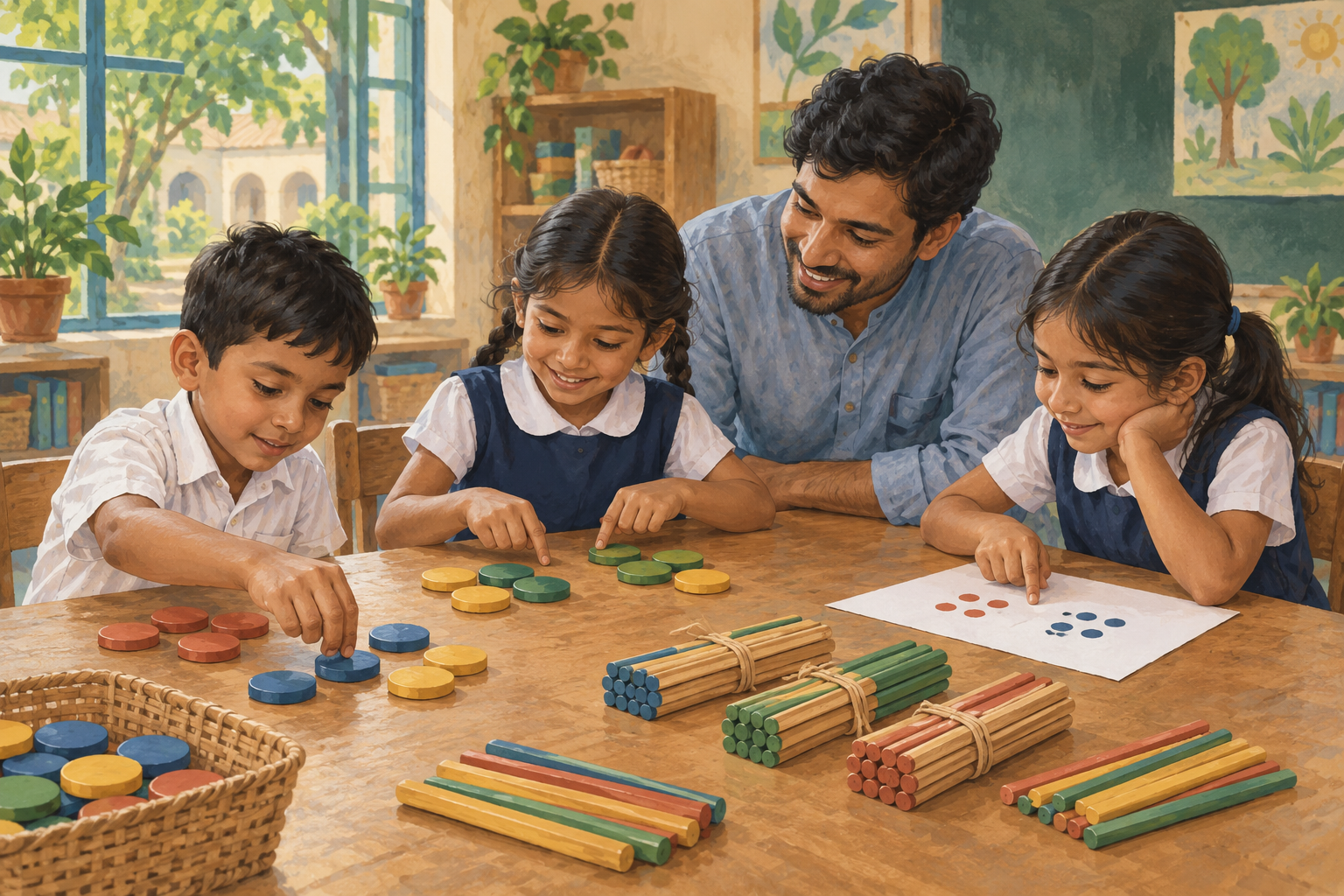
Separate thirteen sticks into one bundle of ten and three loose sticks. Connect the objects with the written number to explore how one ten and three ones represent thirteen. The focus is not just on reading the digits one and three separately, but on how their positions change their meaning.
Then undo the bundle and check that there are still thirteen sticks altogether. As children become familiar with the idea, discuss how to represent twenty-three in the same way. This explores connections between groups and total quantity, beyond memorising how to make a bundle.
4. Move between objects, drawings and equations
A 2021 mathematics guide from the US Department of Education’s IES recommends carefully chosen concrete and pictorial representations. It is not evidence of programme results in Bangladesh. Source: IES’s elementary mathematics intervention guide.
For example, show three blocks with two added, draw the scene as dots on paper, and connect it with 3 + 2 = 5. Asking “Which group does this 3 represent?” makes the meaning of the numbers explicit. If the connection becomes unclear, return to the objects and recreate the scene.
The goal is not to put the materials away as quickly as possible, but to understand that objects, drawings and equations can represent the same quantity relationship. Teachers should also distinguish time for exploring materials from the particular idea a lesson is checking.
After the answer, ask how it was worked out
Finish by trying a question with slightly different numbers or arrangements. Briefly recording a child’s method, such as counting one by one or using groups of ten, can provide a starting point for the next lesson. Avoid fixing labels such as “good” or “bad” at maths from one answer or calculation speed alone.
Frequently asked questions
Are expensive specialist mathematics materials necessary?
Paper cards or blocks can be considered for counting, matching and grouping activities. More important than price or variety is whether learners understand what the materials represent and can handle the required quantities.
Should children move straight to equations once they can use objects?
There is no single rule for everyone. Check whether they can explain the links between objects, drawings and equations, and move between them when needed. Alongside a correct answer, look for understanding of the situation the equation represents.
For KIZUNA’s current work, see its support activities. If you are considering cooperation involving mathematics materials or learning support, please contact KIZUNA to confirm current activities and needs.
This explainer and its lesson-planning examples draw on public sources. It is not field reporting or a report of results from a KIZUNA mathematics programme. Sources checked: 2 October 2026.