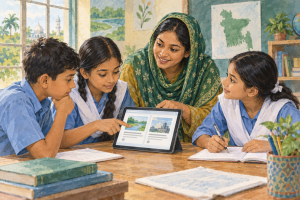
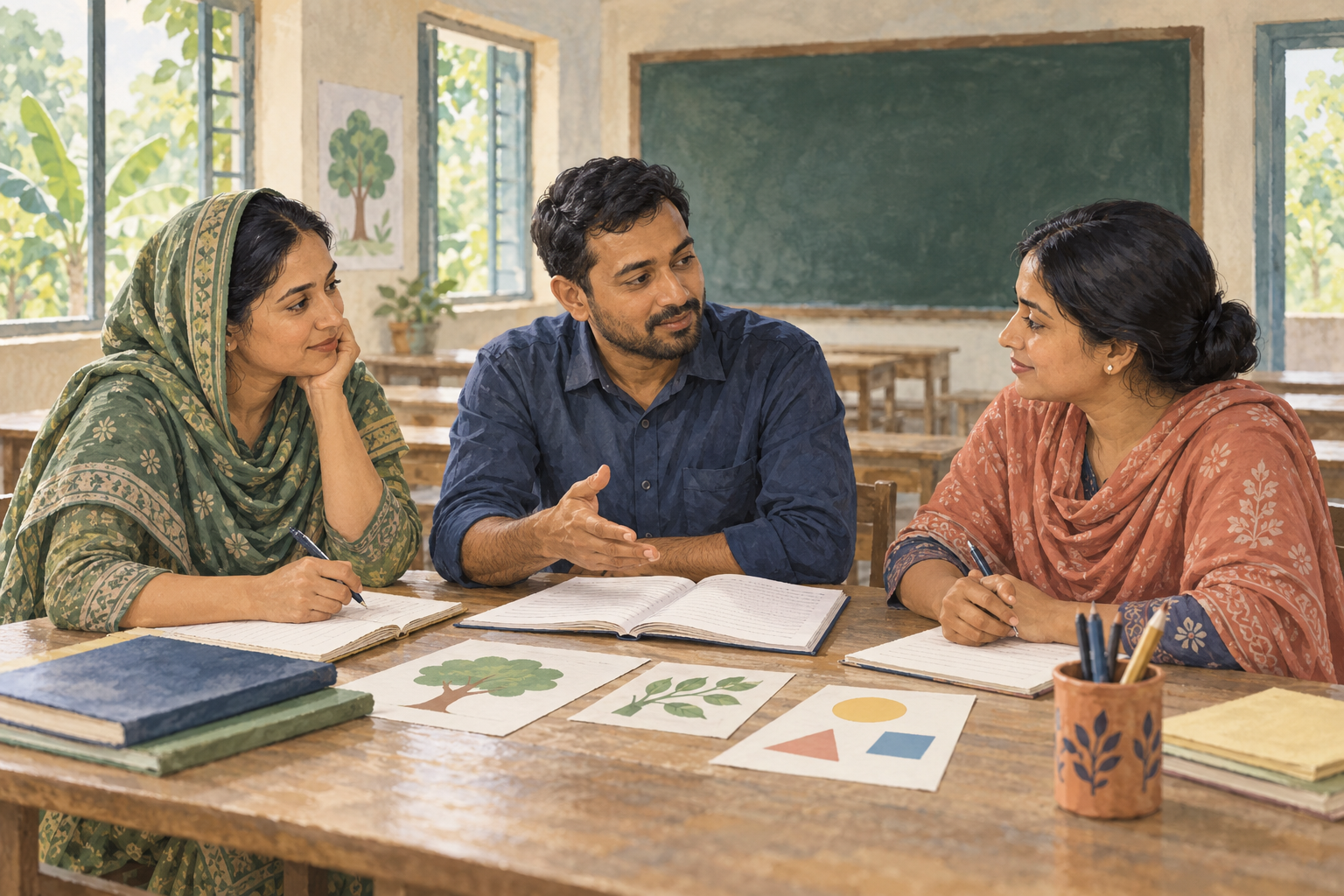
Teachers observe a lesson, discuss children’s responses and make a small change to the next lesson. This cycle is a starting point for learning with colleagues through lesson study. Alongside materials and facilities, education in Bangladesh also involves opportunities for teachers to learn from everyday teaching. Here, the focus is on turning observation into improvement, rather than counting training sessions.
Lesson study in Bangladesh’s cooperation history
A JICA retrospective describes promoting lesson study in a Bangladesh science and mathematics education project: colleagues observe and discuss lessons, then put improvements into practice. It does not establish current implementation in all schools. Source: JICA’s 50 Years in Bangladesh, page 114.
A UNICEF teacher resource recommends agreeing beforehand on the purpose of peer observation and who may receive records. These agreements support mutual learning. Source: UNICEF technical booklet on support for teachers, page 39.
The discussion examples below build on these ideas. They are not reports of lesson study carried out by KIZUNA or results from a particular school.
Choose one question before observing
“Was it a good lesson?” is so broad that discussion can remain at the level of impressions. A question such as “Could children begin working independently after the explanation?” makes the focus more concrete. Start with a moment the teacher wants to understand, rather than searching for faults throughout the lesson.
Tell the observer the lesson’s aim and what you would like recorded. Agree on reference points such as the initial task, the sequence of instructions and what happened before children started working. Even when observing only a short segment, distinguish what it can tell you from what remains unknown.
Separate what happened from your interpretation
After the lesson, one option is for the teacher to explain their intentions and reflections first, followed by the observer’s notes. Rather than saying “they were not concentrating,” a specific observation such as “they asked a neighbour to repeat the steps just after the explanation” gives colleagues something to investigate together.
Several explanations are possible: the length of the instructions, how the task was presented or when materials were handed out. Avoid settling on a cause after one observation. Turn it into a hypothesis: “Would shorter instructions make it easier to begin?” Look for teaching conditions that can change, rather than attributing the issue to a teacher’s or child’s character.
Keep notes focused on relevant learning moments and avoid recording children’s names unnecessarily. Agree in advance who may see notes or photographs. If observations are unexpectedly used for staff appraisal or external publicity, the conditions for discussing difficulties openly have changed.
Select one change to try in the next lesson
End the discussion with something specific to test, such as presenting the task steps one at a time before work begins. Changing instructions, materials, seating and timing together makes it harder to consider what mattered. One approach is to start with a small change and revisit the next lesson through the same question.
When observing again, record both what went well and what did not change. “Some children started promptly, but hesitated when choosing a task” suggests a next question about how choices are presented. Use the record to develop the next inquiry rather than dividing results into success or failure.
A shared one-page note can organize the original question, the change tried, children’s responses and what to check next. If colleagues try the idea in another class, share conditions such as lesson length and grade level alongside it. The same procedure should not automatically become the correct answer everywhere.
Make reflection time part of school work
Continuing lesson study requires arranging cover or schedules around the observer’s own teaching and finding time for a short discussion. Agree when to meet, whom to work with and how much to record. The aim is not more reports, but a manageable process that helps prepare the next lesson.
Frequently asked questions about lesson study
Do teachers need to prepare a perfect demonstration lesson?
In these examples, what matters is a question the teacher genuinely wants to explore. Share uncertainties from ordinary lessons and think together using children’s responses. Make the shared learning purpose clear rather than concentrating on a polished performance.
Does one successful lesson show that an approach works in other classes?
A single observation cannot establish that. Grade level, tasks and children’s understanding may differ, so share the conditions and examine the idea in other lessons. A colleague’s experience can be a useful starting point without becoming a guarantee of effectiveness.
Explore KIZUNA’s current activities on our support programmes page. To discuss contributing to education, please contact us.
Sources checked: 6 October 2026.